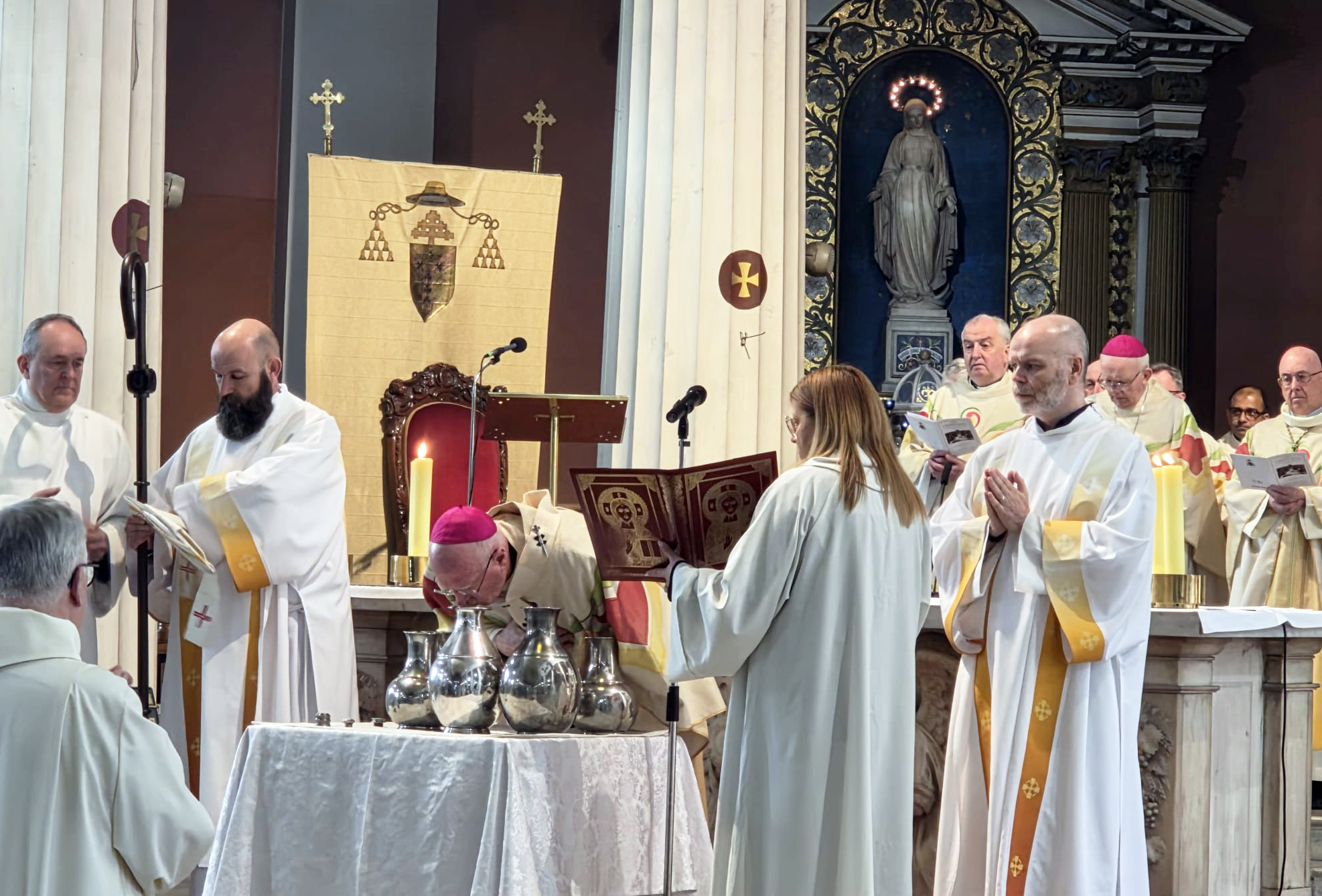
Chrism Mass
St Mary’s Cathedral, Dublin
Holy Thursday, April 2, 2026
Homily of Archbishop Dermot Farrell
Today is the Day We Have—God’s Mystery is Happening Among Us Today
“Today, this scripture has been fulfilled in your hearing.” (Luke 4:21) The key word here for us this morning is today. Today is the day Christ brings good news to the poor. Today is the day he is sent to proclaim liberty to captives, … to let the oppressed go free, and to proclaim a year acceptable to the Lord. (see Luke 4:18–19)
The radical hope of Isaiah, which Jesus makes his own, can blind us to its presence in our lives, and in the life of the Church. Prophecies must, by their nature, be clear and clear-cut. However, their outworking is rarely as clear-cut. That which is proclaimed by Jesus, and is fulfilled in him, is not fulfilled in one fell swoop. The Good News does not happen with the linearity of a ‘feel-good’ story.
Is this not the mystery into which we enter in these days of Holy Week—the paradox and contradictions of God’s way with us and all his creatures? It is that mystery, with all its contradictions, that unfolds in the ministry of the Church and in our ministry. What Christ prophecies is not some vague future, but is, and has been, the story of our lives.
The Powerlessness of Christ
In these days of Holy Week, we not only celebrate a Christ “who rose victorious from the grave” (as we sing in the Exsultet), but we also remember him who joins us in death, who is with all of humanity in our ultimate place of helplessness. Christ is in the place of our ultimate powerlessness, and makes of it, the place of our salvation.
Christ has made our helplessness his own. The chaos of the Passion—its twists and turns, its betrayals and abandonments, is not just Christ’s; it is also ours, as is his isolation and aloneness. Christ not only looks upon our helplessness, but he has also entered right into its heart.
This is also the place of our ministry. Yes, we celebrate and mark the high-points of life—the marriages, the births, we proclaim good news, but like Christ himself, we are also in life in its lowest ebb. It is there that we are ministers of God’s presence and God’s hope—God’s abiding hope for us that enables us to act in ways that we did not think possible (see Matt 5:38–42).
This not some polished future; this is our today. It is in this place that we pray with Christ, “Father, if this [cup] cannot pass unless I drink it, thy will be done.” (Matt 26:42)
The Realm of the Real
Christ’s story is the story of the ministry of the Church, where, in our poverty, the Good News is made flesh in the life of every person; there the wounds of the wounded are bound up. For all our imperfections, and all our mistakes, this is place where God is acting, and is acting today, to create in all people the image of his Son, so that, in the words of Rowan Williams a few days ago, “the human world may see possibilities for transformation that would otherwise be in the realm of fantasy. (Rowan Williams “How to be an Archbishop of Canterbury,” The Tablet (21.03.26): 6, emphasis mine)
This is real priesthood; this is real ministry. This is our priesthood; this is our ministry. You do not need me to tell you that this is not “the realm of fantasy.” And this is where we need to be—even more so today, in this time of war and cynical violence, we need to be in the realm of the real, in the place where God’s Kingdom is close at hand (see Matt 4:17, cf. 26:45).
The Challenge of Ministry in a Weakened Church
The powerless Christ during Holy Week, brings home to us that to minister is not to be involved in some “success story,” but to be so permeated and filled by the compassion and attention of Christ that his life flows into everything we do, so that, day-in-day out, “it is no longer we who minister, but Christ who ministers in us.” (cf. Gal 2:20)
“At the Last Supper,” says Cardinal Timothy Radcliffe, “Jesus had lost control of his life. He had been sold by Judas to his enemies; Peter was about to deny him… The Church begins in this moment of utter collapse. …. [As people of faith,] we have nothing to fear from crises. The Church was born in one and is renewed through them…” (see Timothy Radcliffe OP, “Power and Powerlessness in the Church: The Chance for Renewal” in Austen Ivereigh (ed.), Unfinished Journey: The Church 40 Years after Vatican II. (Continuum, 2003), 119–34; here 120)
Our ministry—both as priests and as lay people—is not just some activity of ours, it is much more. It is our permitting what we do to be the place where the healing and presence of Christ touches the concrete lives of people in their everyday, and in extremis. We are still called to be active in what we do. As Pope Leo said to the clergy of Rome ‘we are not merely inserted into the river of tradition as passive executors of some predefined pastoral plan but, on the contrary, with our creativity and our gifts, we are called to collaborate with the work of God.’ (19th February 2026)
This is not easy today! The sheer magnitude of the changes which have transformed our country and our society, which touch every community and every parish, also require a capacity for change on the part of the Church, ordained ministers and laity alike.
Not Resignation, but Acceptance and Renewal
While Christ was distraught by the enormity of what was unfolding before him on Holy Thursday, it did not paralyse him. He acts: he leads his disciples to the Garden, he prays, he witnesses to who he is before the Sanhedrin, he is himself before Pilate, he carries his cross, he cries his prayer abandonment from the cross. He gives his life. He is the model, not of resignation, but of acceptance. There is a world of difference between those two places. Resignation results in bitterness, a type of living death. Acceptance leads to peace, to healing, and a renewed life.
In the crisis in which the Church now finds itself we are being renewed. As God called Christ to enter his passion, so God is calling us to enter this new time. In Gethsemane, Christ discovered a deep acceptance within himself, a renewed trust in his Father, and the strength to travel the road that was being asked of him. It was the next stage of “This is my body, given for you.” By his life, by his passion and death, Christ calls us too to our next stage of “This is my body, given for you.” To follow him does not mean that we will not fall, but it does mean that we will try, and that resignation, despair, and defeatism, are not given the upper hand. Nobody knows what the Church in Dublin will look like in 10 years’ time. But neither did Pope John XXIII know what the renewed Church would look like when he announced the Second Vatican Council! The future of the Church is in God’s hands! How we welcome that future is in ours!
God’s Future for Us
Christ’s future was in God’s hands. That is the meaning of the Resurrection. But Christ trusted his Father; he welcomed his future, difficult and all as it would be. The call for us, as we bless these oils, is whether, in our ministry, we can welcome God’s future for us in a Christ-like way, with his trust in his Father, and his hope in the One who sent him into world. The future that God is giving his Church is a future that is already visible in people who seek a way of working with each other for the sake of the little ones. The future God is giving us is already charactered by lives that are taken up into the mystery that is Christ, by lives that are drawn into the One who is the light of the world. This is the future, which already unfolds among us. A living faith, that trust which Jesus had in his Father, is a faith that welcomes that future by the way we now live. It is not a question of age, it is not a question of numbers; it is question of our willingness still to be servants of our ever-living Lord in this new time.
“May the eyes of our hearts be enlightened, that we may know the hope to which he calls us.” (cf. Eph 1:18)
+Dermot Farrell
Archbishop of Dublin
Archbishop Farrell prayed this prayer of Pope Leo XIV with the priests and people of the Archdiocese at the conclusion of the Chrism Mass
 Donate
 Volunteer
 Mass Times