St Philip the Apostle, Mountview
3rd Sunday of Easter, 2026
Catechists: Witnesses and Accompaniment
Homily of Archbishop Dermot Farrell
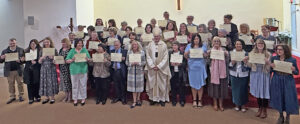
Today’s readings are very apt as we celebrate this Mass for the forty-two catechists who have completed their formation programme.
In the First Reading we hear how the apostles were witnesses to the life, death, and resurrection of Jesus. (Acts 2:14, 22ff) It was the power of their witness that drew many people to follow Jesus. It was through their fearless witness that many heard the life-giving message of the Gospel. You too as catechists are called to witness to your encounter with the Lord.
The power of witness is very evident in the life story of Madeline Delbrêl (1904-1964), a French Catholic laywoman. After an adolescence of agnosticism, she was struck by the witness of some of her friends. She converted. Captivated by an encounter with the Lord, she said that, “once we have come to know the word of God, we have no right not to receive it; once we have received it, we have no right not to let it be incarnated in us; once it has been incarnated in us, we have no right to keep it for ourselves: from that moment on, we belong to those who await it” (La santità della gente comune, Milan 2020, 71).
You know about the power of such witness from your formation. The Directory for Catechesis (2020) put it this way: “The catechist is a witness of faith and a keeper of the memory of God.” (113a). As a catechist you must be able to share your experience of encounter with Jesus. What keeps the memory of God alive in the Church is women and men who can speak about their encounter with the Lord.
Pope Saint Paul VI reminded us of this when he said, “if modern people listen to teachers, it is because they are witnesses”. (Evangelii Nuntiandi, 41) If a catechist is not willing or able to share their experience of encounter, then it will come across today as lacking in authenticity and credibility in the real sense of the word – it will not be believed. How often does this happen to us? We talk about God, about Christ, about the Church, about faith, and yet fail to see Him present, alive, walking beside us. The quality of your personal witness as a catechist will have far more impact than the quantity of input you may give in talks. The primary purpose of all catechesis is to “put people not only in touch but in communion, in intimacy with Jesus Christ.” ( Pope Saint John Paul II’s Apostolic Exhortation Catechesi Tradendae [1979], 5)
The Gospel account of the two disciples who were walking on the road to Emmaus, unable to recognise the Lord who walked alongside them, is the most beautiful of all the accounts of the appearances of the risen Christ. It is our story.
The hope of the disciples had died when Jesus was crucified; they thought they were left with nothing. To the stranger who comes alongside them and walks with them they tell their story. “Our own hope had been”, (24: 21) they said, as they walked and talked with him. “Our own hope had been” are words that are on our lips as we face an uncertain and confused future because of the various crises unfolding before our eyes. The stranger listens to them, and he tells them another story. His story changes their perspective. They move beyond their own self-interest and invite the stranger to stay with them. When the stranger takes the bread, blesses it, breaks it and gives it to them, they recognise him. Their eyes are opened, their hearts burned within them and they begin to see a future beyond their expectations. At every Mass, we repeat these actions of the Lord: we take bread, we bless it, we break it and we give it to each other. At every Mass we are called to recognise Him in the world around us, to let our fears be transformed, to let our spirits be raised, to receive the courage to face new realities, and find new heart for the road ahead.
In this encounter Jesus does not interrupt their journey. He enters it. He begins not with answers, but with a question: “What are you discussing as you walk along?” (24:17) He opens up a conversation, asking questions only when the moment is right, leading to a dialogue that leads the disciples into reflection on their experience which, in turn, leads to a moment of recognition or insight.
Jesus accompanies them. This is a key role for any catechist today. Jesus models for us what it means to be a catechist. A catechist walks with others in their journey of faith, listens deeply to stories of life and faith, enters into a dialogue of persons, connects with teachable moments, and enables encounter. Accompanying others is an essential feature of the work of the catechist. This is needed more than ever today where people are doubting, questioning, or even rediscovering their faith.
We are often like those two disciples. First, we are walking in the wrong direction. Instead of traveling to Jerusalem, our heavenly home, we are often on a journey that leads us away from our destiny, our true home. Second, although we hear the scriptures week after week, we often fail to understand what they are saying about our lives. We do not read Scripture to find out about what we don’t know or have forgotten, but rather to let the pattern of the biblical story continue to form us. The Gospel is the book of the Lord’s life. It is there to become the book of our life. It is not there to be understood, but to be approached as the threshold of mystery. Like the Eucharist, it is not there to be read, but to be received within us. Each of its words is spirit and life… (see The Joy of Believing, [1993] Madeleine Delbrêl, p25). Finally, we often fail to understand that the risen Christ is always walking with us, even when we do not see him.
In your training you have learned that a catechist must be able to listen well, practise patience with the gradual growth of others and be open to the action of the Holy Spirit at work in every person. This is why you must be a travelling companion, just like Jesus, and help others to recognise the presence of Jesus in their lives. This is perhaps for many a new style of catechesis, a new way of approaching catechesis which very often in the past was more about a book—questions and answers—than a person, Jesus Christ.
When catechists accompany people, they are touched by the questions of those they are walking with, respecting their freedom. Like the disciples on the road to Emmaus, listening becomes a springboard for building trust and enabling participants to see how their life story connects with the story of Jesus.
The aim of this accompaniment is to grow in relationship with Jesus and respond more fully to the call of discipleship. Ideally you will help to build a community that can walk with others in their journey of faith. Taking up the Emmaus image, we walk together as a community, supporting each other on our ongoing journey of faith.
Being accompanied in the Christian way of life is not just a personal journey: we walk together as a community on the journey of faith. By being accompanied in the Christian community, we can learn how faith is lived, prayed, celebrated, and believed.
Through your ministry, I hope that you can enable your community to accompany others on their journey of faith. We are a community of disciples.
I also hope that you will have the courage to witness to your faith, so that others will discover how encounter with Jesus transforms us.
We pray for the transforming hope of the disciples and its light for our lives. The risen Christ is always walking with us.
+Dermot Farrell
Archbishop of Dublin
 Donate
 Volunteer
 Mass Times