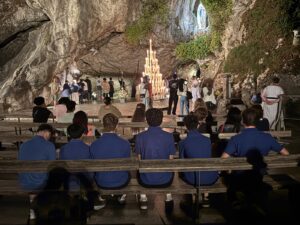
Mass at the Grotto of Lourdes
Friday, September 4, 2026
Homily of Archbishop Dermot Farrell
“Truly the Lord is in this place… How awe-inspiring is this place … this is nothing less than… the gate of heaven!” (Gen 28:17) Here in Lourdes, we are in an awe-inspiring place. For all of us who come here, Lourdes is a place of hope, and a place of faith. And it is more: Lourdes is a place of truth, where we come to see what truly is and what truly matters. The words of Jacob in the First Reading are our words too: “Truly the Lord is in this place,” (see Gen 28:17) and we see the fruits of his presence in the acceptance and healing, and transformation which unfold here for so many.
To come to Lourdes is to come to a place where change is put before us. One of the characteristics of the Lord’s presence is that we begin to be aware that there is more than our own conviction at play, something greater than our human effort is at work. In this place, a rockface beside a small river, the Virgin Mary appeared to Bernadette. The closeness to Heaven, and the closeness of the Kingdom, and its healing, are still in this place.
There is more than a coincidence between the Story of Mary and the story of Bernadette: both came from unknown places (see John 1:46), both young women in a society where women were often invisible. Both women were courageous, both overcame their hesitation and their fear, and both have much to teach us about prayer, and about life.
In today’s Gospel we hear Mary’s great prayer, the Magnificat. The Magnificat, however, is more than a great prayer, it is a School of Prayer, and even more than a School of Prayer, is a School of Life, as authentic prayer always flows out of the lives we actually live. The Mother of our Lord shows us how to follow her Son, how to welcome the life he offers us: “Do as he tells you,” as she told the servants at Cana (see John 2:5).
Mary’s great prayer can teach us many things about prayer and life; I’d like to underline three of them: First, Mary’s prayer is a prayer born of Scripture. She makes her own the Song of Hannah from the Old Testament (see 1 Sam 2:1–10). She prays to God, in the words of God. Second, Mary’s prayer is not a prayer turned in on herself, but a prayer turned towards God, our Father.
And third: Mary’s prayer is a call to living like Jesus, to prophetic living. To live as Christ lives is our way to salvation, to life itself. The Magnificat is a song of reversal, a hymn of praise to God the Father, for the mystery of His way. It prefigures the prayer of Jesus that we heard a few weeks ago, where he prays “I bless you, Father, Lord of heaven and of earth, for hiding these things from the learned and the clever and revealing them to mere infants.” (Matt 11:25).
Mary prays, “he casts the mighty from their thrones and raises the up the lowly.” (Luke 1:52) Here in Lourdes we are in a place where the lowly are raised up. Think of St Bernadette herself! A living parish is a community which has an eye for those who are left behind, not just in material things, but also in the people’s dignity, in their possibilities for hope and for joy.
The challenge for us, of course, is to know how we engage in the establishment of justice. “We cannot remain as unengaged spectators,” as Pope Leo said on Wednesday, “rather, we must listen with our hearts, allow ourselves to be challenged, and become involved.” (General Audience, Wednesday, September 2, 2026) Sometimes, it seems that injustice is so embedded in the fabric of our lives that it is almost inconceivable that things could be ordered differently. Indeed, the great power of those who dominate our societies is to turn their version of reality into what gets accepted as common sense.
The radical vision of Mary’s prayer goes far beyond a call to acts of charity. It brings us to live with compassion and solidarity and, ultimately, to the struggle for what is right. The mighty have rarely been content to step meekly (see Matt 5:5) from their thrones, and the rich remain rich, by making sure they’re not “sent empty away.” (see Luke 1:53)
In order to break free of the paralysing grip of the status quo, we need to see things as they truly are, not as others would have us see them. An obvious example of something which has been normalised to the point where we are no longer exercised about it, is the housing crisis, especially in our capital city. Is it not extraordinary that almost a whole generation of young people have all but given up the hope of having a home of their own? Living with parents long after the time when people would expect to live independently, seems often to be the only alternative to emigration. And those who do find their own place often experience unrelenting financial pressure in paying their rent or mortgage.
But, even more than this, is what one might call the hidden homelessness that is ubiquitous at home in Dublin and throughout Ireland. How visible are the young adults who live with relations, or the increasing numbers of families with children who rely on emergency accommodation? I acknowledge that the situation is complex, and that many initiatives have been taken and substantial public funds invested in alleviating what all accept to be a housing crisis. It is also true that initiatives take time to have an effect, and that increasing housing supply—which is ultimately the only effective response to unmet demand—cannot be achieved overnight.
That said, can we really say that the crisis which is blighting the lives of so many, is an overriding concern in our society? Do we see vested interests being challenged? Are established ways of doing things being set aside? Are property rights, and other rights, being reconsidered in the face of such gross denial of people’s basic right to housing? And what about the exploitation of those who are vulnerable through their precarious housing situation? It is not a law of nature that requires landlords to extract the highest possible rent from their tenants. It is not a technical inevitability of housing management, that those who control property exploit the desperate by packing them into disgraceful living conditions, overcrowded, ignoring basic standards, and which have the renter pay dearly for this “privilege.”
If we cease to be shocked; if we dismiss our anger; if we continue to look the other way, then this injustice and the suffering it causes will continue. But the really challenging aspect of reflecting on our housing crisis in the light of the gospel, is that the finger also points not only at the government, not only at international investors, not only at planners or developers, it points also at ourselves. Part of being a person of faith is embracing the stony path to justice. Justice always comes at a cost. If we own our homes, might we secretly be hoping that the crisis continues so that property values remain high? If we enjoy a pleasant environment with many amenities, does that increase our silent sympathy for those who submit planning objections? When it comes to election time, do we support those we think will allocate resources that benefit us, rather than to those whose needs, including housing, are the most urgent?
This examination of conscience is for us all: it is not just for those who are comfortable, it is also for our diocese, and for all the religious organisations in our Church. We are all called to reflect anew on our use of resources, our property, and our land (see Laudato Si’…93 “The earth is essentially a shared inheritance, whose fruits are meant to benefit everyone.”)
Mary praises the Lord because of his faithfulness to his promise of mercy (see Luke 1:54-55). Lourdes is a place where mercy is never far away. Here, we are moving in the gate of heaven. We live out God’s mercy in the way we walk with each other, and carry each other. As we pray in the Our Father, “forgive us our trespasses, as we forgive those who trespass against us.” (Matt 5:12) Nobody can tread the path of forgiveness in our stead.
“How awe-inspiring is this place! This is nothing less than the house of God; this is the gate of heaven!” (Gen 28:17) May our days in this place, where Heaven touches Earth, help us to grow in awareness of all the gateways to heaven that the Holy Spirit opens before us.
O Mary, who appeared to Bernadette in this place, help us to hear the voice of your Son.
O Immaculate Conception, fill us with your hope in your Son.
St Bernadette, woman of faith and courage, pray for us.
+Dermot Farrell
Archbishop of Dublin
 Donate
 Volunteer
 Mass Times