Service of Prayer for the
Opening of the Academic Year
Trinity College, Dublin
Thursday, October 1, 2026
Address of Bishop Paul Dempsey,
Auxiliary Bishop of Dublin
One time Albert Einstein was asked, who was the smartest person he knew? To everyone’s surprise he answered, his chauffeur. He explained that one time he was on his way to a conference exhausted and not feeling his best, his chauffeur, who heard his lecture countless times offered to deliver it for him. So they switched clothes and roles, they were somewhat similar in looks and since few had seen his face back then, no one noticed. The chauffeur stood up at the podium and delivered the speech flawlessly, while Einstein sat back in the front seat. When the chauffeur finished delivering the lecture, a journalist stood up and asked a really challenging question about the Theory of Relativity. The chauffeur paused for a second and then calmly replied, actually that question is quite simple, so much so that I’ll let my chauffeur here in the front row answer it. Einstein stood up and gave a brilliant answer, the audience was stunned. I like that story because it illustrates that intelligence and wisdom are two different things. The chauffeur in this case, one could say, possessed both. He could deliver the lecture, but more importantly, when the serious challenge came, he possessed the wisdom to deal with it. As I stand here, I’m very conscious that this is a place in which knowledge, learning and imagination prosper; it is a place of academic freedom; of integrity in teaching and research and is built upon the idea that “enquiry is the door to wisdom.”
This idea of ‘enquiry’ and the ‘door to wisdom’ is especially worthy of reflection as this academic year commences. We are aware of the extraordinary changes that are happening in this moment, some argue we are living through an existential crisis. This could be partly due to the amount of information we are dealing with. Today more than at any point in history we have so much of the world inside our heads. I heard one commentator put it well, he said ‘before we even get out of bed in the morning one can see people die in a war thousands of miles away, you can observe a political argument, you can hear someone tell you that everything you know about relationships is wrong. We have access to every opinion, lifestyle, belief, tragedy and possibility and we can experience all this before 8am!’ As a result, many are questioning their values, beliefs, and relationships. This leads to an overarching question, what is the point of it all?
This is particularly relevant in the age of Artificial Intelligence. As we know the power of this source means that a book can be summarised in seconds, languages can be translated, computer codes written, it can generate an essay, an image, a piece of music, a legal argument, a scientific hypothesis. Paradoxically, the easier it becomes to obtain answers, the more important it becomes to know which questions are worth asking. It is in this context that Pope Leo XIV, offers his encyclical Magnifica Humanitas, promulgated just four months ago and devoted to protecting the human person in the age of artificial intelligence.
The Pope compares our moment with the great industrial transformation addressed by Pope Leo XIII in Rerum Novarum in 1891. Leo XIII confronted a world transformed by industrialisation, with new forms of work, emerging poverty and new questions about the relationship between capital, labour and human dignity. Leo XIV argues that artificial intelligence represents another transformation of comparable historical significance. Pope Leo understands the great advantages that Artificial Intelligence has contributed but he sees a serious risk that we will cease to invest in things that make us human. There is the fear that a machine will handle things such as meaning, creativity, moral judgement and how we approach relationships. In presenting his encyclical at this time he is inviting the human community into a conversation about the challenges AI poses. He speaks of the need to listen to scientists and engineers, political leaders, parents and teachers, and of the importance of people with different forms of expertise and experience learning to discern together. This is a profoundly university like idea. The university, at its best, is a place where different kinds of knowledge meet. All of them need one another because no single discipline contains the whole truth. In our engagement with one another we grow, learn and are immersed into the great mystery and adventure that life is. The university is not a museum of information. It is a place where inherited knowledge and experience encounter the new questions emerging today.
One of the most significant new questions we face is about the dignity of the human person in the age of Artificial Intelligence. Magnifica Humanitas insists that each human being is unique and irreplaceable, a free and intelligent subject. This has important implications for university life. A University such as Trinity College is a large complex web of relationships. There are students, lecturers, professors, chaplains, administrative staff and others. We must never forget that behind every academic function is a person. The task of a university is to create the conditions in which the person can flourish in life.
To flourish one has to develop the whole person, it is not merely about feeling happy or achieving goals and avoiding suffering. It involves grappling with the big questions, pursuing meaningful relationships, making mistakes, and living an authentic life coherent with one’s values. All of this takes time. With Artificial Intelligence there may be the temptation to seek the short cut, the easy way, what has become known as ‘cognitive displacement’, but genuine education is rarely like this. If a machine does the thinking for us, the immediate product may look impressive, but something has been lost. The purpose of a university is not merely to produce answers. It is to form people who can ask the right questions, recognise a false argument, understand another person’s point of view, tolerate ambiguity, revise their judgement and accept responsibility for what they do and say. These are human capacities that enable us to grow and reach our potential.
We know that those being educated here in Trinity will also face new challenges in the world of work. I served as a priest in the north Kildare area for over 20 years. It is the place where many of the very large tech companies are based. People have highly paid jobs that contribute to the local economy in so many positive ways. However, things are changing and there are questions now around whether these jobs will survive into the future. People are nervous. These questions are not only relevant for those employed in tech companies but also apply to the medical, legal and academic fields. There is no doubt that some tasks will disappear, others will be transformed, many professions will increasingly involve working alongside intelligent systems. But Magnifica Humanitas asks us not to reduce work to mere economic productivity. Work has a human meaning. People work not only to produce things and earn money. They work to contribute, to serve, to create, to connect with others, to develop their abilities and to participate in society. If education is merely a preparation for employment, then perhaps the university’s task is simply to give students the skills demanded by the labour market. But if education is about something greater, like helping the person to grow and flourish, then the task is much larger, it involves a more searching question of the university, namely, What kind of human beings are we becoming?
The title of Pope Leo’s encyclical, ‘Magnifica Humanitas’ or ‘Magnificent Humanity’, ultimately points beyond artificial intelligence. It points towards a vision of the human person that cannot be replaced by a machine. The title reminds us that human beings possess a splendour which technology does not create and cannot confer. In a university like Trinity, whose community is ecumenical and contains many faiths and none, an important question emerges out of this, that is, what do we mean when we say that a human being possesses a unique dignity?
Christians explore this question through the prism of Christian Revelation. From this perspective, Pope Leo is clear that the value of the human person does not depend on what they achieve or produce, the fundamental dignity of each person is neither acquired nor earned, it does not need to be justified. For Christians, the grandeur of the human person has its deepest foundation in the belief that humanity is created out of love in the image of God and has an innate dignity. Others will approach this question through philosophy, ethics, literature or their own religious and humanist traditions. The university is precisely the place where these conversations can take place, not by pretending that we all agree, but by encountering and listening to one another so that we can learn and grow together in wisdom and love. This is needed now, more than ever!
One final theme in Magnifica Humanitas that I think is especially appropriate for the beginning of the academic year is the theme of hope, not optimism, but hope. Optimism says that everything will turn out well. Hope is more demanding. Seamus Heaney reminded us that ‘Even if the hopes you set out with are dashed, hope has to be maintained.’ Pope Leo concludes by calling people to become, in his words, “artisans of hope”. We are called to be people who help build the future rather than simply waiting for it. This, I believe, captures the vocation of the university. An artisan works patiently, pays attention to detail, knows that something worthwhile takes time. An artisan knows that the material entrusted to his or her hands is precious and must be treated with care. The material entrusted to a university is not simply information, it is human life! It is concerned with the future of society and of the world.
In the Gospel from Matthew this evening, on this Feast of St Thérèse, Jesus sets a child before him and tells us that we must change and become ‘like little children’. It is a somewhat unusual invitation, but when one reflects upon it, a child lives a life inspired by wonder and inquiry, he or she approaches the world in an imaginative way. Perhaps Jesus is indicating that to be truly wise we should never lose our sense of wonder and imagination. We are invited to stand in awe before the beauty of creation and central to this is the unique dignity of every human person.
This college has lived through enormous changes in intellectual culture and Irish society over the centuries. Its own history describes a long process of adaptation to a rapidly changing world. Each one of you is a significant part of the living story that is Trinity College, Dublin, today. As you begin this academic year, may you know that enquiry truly is the ‘door to wisdom’. This gift of wisdom is needed now more than ever. May you be inspired as you open your minds to the pressing questions of today and your hearts to the wonder that is human life!
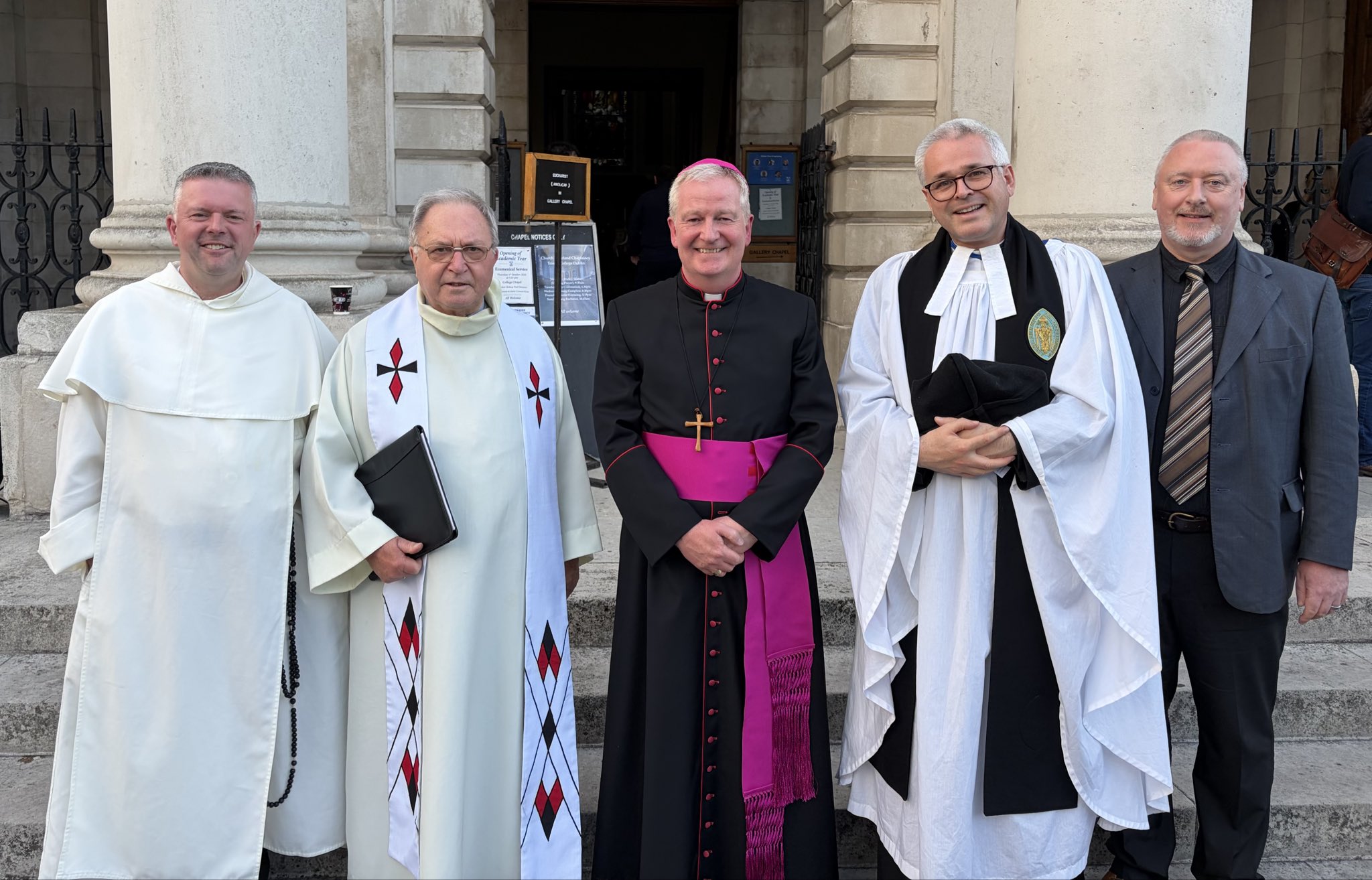
Pictured: Bishop Dempsey with the chaplaincy team at the College Chapel, Trinity College, Dublin
 Donate
 Volunteer
 Mass Times