Feast of Our Lady of Mount Carmel
Whitefriar Street Church, 16th July 2026
Homily of Archbishop Dermot Farrell
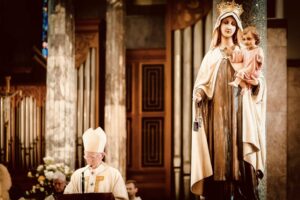
Today’s patronal Solemnity means a great deal to everyone gathered here in Whitefriar Street Church, a joyous and deep-felt moment in which we celebrate our devotion to the Mother of the Lord, under the very popular title of Our Lady of Mount Carmel. Our Lady of Mount Carmel is for Carmelites a model of prayer, dedication and contemplation, but for everyone, an image of hope. Our imagination allows the image of Our Lady of Mount Carmel to become a portal into heaven, an invitation to encounter and reverence the incarnate God.
When you pray the liturgical prayers for this Marian feast clearly the Virgin Mary is the great trailblazer who co-operated in Jesus’ public ministry. (Pope John Paull II, “Mary had a role in Jesus’ public ministry”, L’Osservatore Romano, 19th March 1997, 11) She is the one who went ahead, to open, and to mark out the path that we are called to follow, “so that fortified by her protection we may reach the mountain which is Christ.” (Opening Prayer for the Feast Day). Today we also ponder our own, yes, our own human response God’s gift of himself, and we invoke the help of the Mother who does not shield herself from the risk of encounter, but embraces it in advance, with generosity. Today’s feast honours the Virgin Mary, of course. But it also makes our own Christian vocation explicit to be Christ’s mother and siblings by hearing His words and acting on them. (see Matt 12:46-50; Mark 3:31-35 and Luke 8: 19-21).
This depiction of Mary has endured for eight centuries and moved so many women and men to connect or build a bridge between our life and the one we are promised in Christ. From 1251 people have felt the invisible nearness of our Lady of Mount Carmel. It is a beautiful mountain in the north of Israel whose slopes run down the eastern coast of the Mediterranean Sea at the altitude of Galilee. Its slopes are dotted with numerous natural caves, beloved by hermits. It is a special place of grace.
We must speak of the prophets of Mount Carmel. For Elijah, as well as his disciple Elisha, Mount Carmel was the place of encounter with God. (1 Kings 19:9, 11-13) This is a God who may not come to us in some dramatic natural phenomena, but in quiet, almost unnoticed “tiny whispering sound,” also rendered “a sound of sheer silence.” It is a reminder to us that we can neither plan the road along which God will travel, nor limit our view of God’s ways to those we have plotted. Life is mostly composed of the tiny moments, the unnoticed kinds of things that a child would notice while an adult might ignore them: a newborn with his mother in a stable; a still, small voice; a bush on fire that only the person who watches it for a while will discover is not consumed. “And when Elijah heard the gentle breeze, he covered his face with his cloak.” Like Elijah may we too be silenced by the mystery of God and discover the threshold of God’s presence within.
In the First and Second Book of Kings, we see these prophets of Mount Carmel performing one miracle after another, all meant to bring people back to the worship of the one true God. How important it was that these two prophets, one following the other, made sure that their work was always oriented to making the Word of God known through His people.
The most famous of these men of God was the great Prophet Elijah, who in the ninth century before Christ strenuously defended the purity of faith in the one true God from contamination by idolatrous cults (1 Kings 18: 20-40). Inspired by the figure of Elijah, the contemplative order of Carmelites trace their spiritual lineage to him. The Carmelite religious family counts among its members great saints such as Teresa of Avila, John of the Cross, whose “mysticism is one of ‘open eyes,’ that is, not detached from history” (Pope Leo XIV, Madrid, 6th June 2026).
Other saints in the Carmelite family include: Thérèse of the Child Jesus, Teresa Benedicta of the Cross (in the world: Edith Stein), and Blessed Titus Brandsma. These spiritual children of Our Lady of Mount Carmel are a sign of contradiction to the world. Their way of life is grounded in the present moment, displaying to us, as the prophets of Mount Carmel do, that “the now” is the bridge that unites time and eternity. Thérèse of Lisieux captures this succinctly:
My life is but an instant, a passing hour,
My life is but a day that escapes and flies away.
O my God! You know that to love you on earth
I have only today!
(“PN 5, My Song for Today,” in The Poetry of St Therese of Lisieux: Complete Edition, 1995, p 50).
To come to Whitefriar Street this afternoon is to come to Mary, Mother of the Lord, and Mother of the Church. To come here is to risk being inspired by her, by her faith, her trust in God’s word, her confidence in God’s power, her abandonment to God’s will for her: “Be it done unto me according to thy word” (Luke 1:38). To be inspired by Mary’s faith is, at the same time, to turn more deeply towards the Lord. It is to risk conversion. It is to risk embracing the way of Jesus. The Jesus we hope to follow, he to whom we pray, has become one like us in all things but sin (see Hebrews 4:15). He is the one who understands us and all our hopes and fears, our disappointments and losses, our feelings of abandonment. May we, like Jesus who shared our suffering in the depths of himself, be able to say in the face of challenges: “Father, into your hands, I commend my spirit.” (Luke 23:46) To be a person of faith is to be like Mary, the Model of Faith, who discovers confidence in the Lord. Today, may the Holy Spirt, whose power came upon her, give us also the hope and courage to be like foolish, weak Peter, and say, “Lord, to whom shall we go? You have the words of eternal life…” (John 6:68). “May the Virgin Mother help us to live always in communion with Jesus, recognizing the work of the Holy Spirit who acts in him and in the Church, regenerating the world to new life.” (Pope Francis, Angelus, 10th June 2018)
The Carmelite charism consists in living their fidelity to Jesus and serving Him faithfully through a commitment to seek the face of the living God through prayer, fraternity and service. May this celebration touch our hearts, inspire our living of the charism, and transform our lives so that we will remember the words of Jesus in which he distances himself from his own family: “Who is my mother? Who are my brothers? . . . Jesus turns to the crowd around him, and he creates a “new family” united to each other in the Holy Spirit with the words, “Here are my mother and my brothers. Anyone who does the will of my Father in heaven, he is my brother, and sister and mother.” (see Matt 12:46-50) The appearance of Jesus as a representative of God’s kingdom calls for a radical decision, and nothing can have a higher priority, not even the closest natural ties in this world. (see Mark 10:17-31) As his disciples today we are called to go forth and do the will of Jesus and his heavenly Father, bringing God’s healing to the wounded, his revolutionary power of tenderness and affection to the broken hearted and his peace to the world. “With the same faith as Mary, let us become “weavers of hope” in our world, sharing who we are and what we have, so that the presence of Jesus may grow among us and his Kingdom take shape.” (Pope Leo XIV, Magnifica Humanitas, 245)
May the Blessed Virgin Mary, Mother, Queen and Flower of Carmel, accompany your steps and make fruitful your daily journey to the Mountain of God.
“O Beautiful Flower of Carmel, most fruitful vine, splendour of heaven, holy and singular, who brought forth the Son of God, still ever remaining a pure virgin, assist us in our necessity. O Star of the Sea, help and protect us. Show us that you are our Mother. Amen.”
+Dermot Farrell
Archbishop of Dublin
 Donate
 Volunteer
 Mass Times