Mass of the Holy Spirit
for the Opening of the Law Year
Monday, October 5, 2026
St Michan’s, Halston Street, Dublin
Homily of Fr Paul Churchill
(This Mass was celebrated by Archbishop Dermot Farrell, Archbishop of Dublin. The homily was delivered by Fr Paul Churchill, Judicial Vicar, Interdiocesan Marriage & Metropolitan Tribunal)
The principle of Truth was put before us in the Gospel. Before he condemned Jesus to death, we are told that Pilate had three times declared that he found no case for putting Jesus to death. But under pressure he buckled. So many artists have depicted that scene with Pilate seated in the judgement seat. Those, however, who are expert in Koine Greek, the original language of the Gospel, say that the actual expression of St John is much more ambiguous. You can also, apparently, read the text as meaning that Pilate put Jesus in the judgement seat. St John wants to make a point: namely that the true judge was Jesus. As Jesus said, “For this I was born and for this I came into the world: to bear witness to the truth” (Jn 18:37). Truth is the principle that should guide any judge or court official in his work. Not the mob, nor social media, nor political pressure. Pilate’s final decision warns us that we can betray truth and justice. So, knowing our own weakness we ask the help of the Spirit of Truth.
In 1980 the then Pope John Paul II, now Saint, gave an address to the Roman Rota which could be subtitled: Truth, the Mother of Justice. While the great Pope was focusing on the Church’s marriage nullity process, he returned again and again to the principle: Truth as the way to set you free and give you peace; truth as the mother of Justice. The object of the trial is justice through ascertaining the truth. And those involved in the work of Justice, be they the judge, or advocates to the parties or indeed the participants either as parties or witnesses, must work for the truth. That is the point of the oath de Veritate dicenda, which is consistent with the purpose of the trial. Each party and witness can err, have a personal psychology that causes them to see life through certain hues, but if they are sincere in sharing the truth as they know it, then the judge is likely to have a better grasp of the case by the time he comes to judgement, rather than one where perjury, fraud or trickery are at work.
In 1944 Pius XII exhorted not only the witnesses but also all who partook in the trial, and that includes every official, not to depart from truth. Pilate did just that. He dodged truth. “Truth. What is that?” But I ask all of you to hear Jesus call you to follow truth: do not abandon truth. In your personal hearts love truth and take care to avoid those easy slopes that can bring you to color reality, or put a spin on events that re-write truth. We should all be alert to the seduction of exaggeration or minimizing. Client confidentiality has to be respected but is it right that officials twist reality so as to undermine truth? A medieval canonist laid down a principle: an advocate should never espouse a bad case. By that we do not mean that even the most guilty cannot get legal help. But it challenges an advocate to ensure that justice is achieved through bringing out the whole truth, including mitigating circumstances.
In his 1980 Address to the Rota, Pope John Paul said that the judge must keep in mind the possibility that, during the instruction, the objective truth may have been obscured by shadows brought about by different causes, such as the forgetting of some facts, their subjective interpretation, carelessness and sometimes malice and fraud. The personal psychology of each person can influence what they recall and how they relate that. Putting parties and witnesses at ease and showing them respect and encouraging them may draw out a better version of the truth. The last thing you need to do is overawe them, scare them, make them feel small. That can produce psychological reactions that may cause them to freeze or to close down or frighten then into some exaggeration or silence.
Another reason to ask the help of the Holy Spirit of truth is for the sentence you impose. We hear complaints about sentences being too harsh or too lenient or leading to overcrowding of prisons. Making the right determination in each case is not always easy. What about the case of person involved in drugs who had already been an addict before birth since his mother was, at that time, on heroin or cocaine. Or what about some offender whose root problem lies in too punitive a regime suffered as a child at the hands of father or mother or both? How can more punishment help? Okay, I understand and we all understand that for the protection of society some have to be kept in jail but is that the best for every crime? Again the need of the light of that Spirit of Truth and Wisdom.
In case you are wondering, I have not forgotten that so many of you do not work in the service of the courts. Let me then encourage the great work that so many of you do in putting oil on the cogs of life so that it can run smoothly and so prevent issues coming to court or trial. That hidden work in society should not go unappreciated even if it never makes the headlines. You ensure wills are made clear, you look after Probate, you settle the sale of properties, help frame laws and policies, you mediate and so on. There too the great need for clarity and truth is so important if disputes are to be avoided.
I began in St John’s Gospel, let me return to it. In Chapter 4 we are told of Christ meeting the woman at the well of Samaria. He says to her: “Henceforth, those who worship will worship in Spirit and in Truth” (Jn 4:24). I was always struck by that: to worship in truth. Every time we say the truth, own the truth, work for truth, we worship God.
Your call is to serve the truth as mother of justice and so I do pray the Holy Spirit of truth on your work. Befriend the Holy Spirit. He will lead you to the whole truth (Jn 16:13).
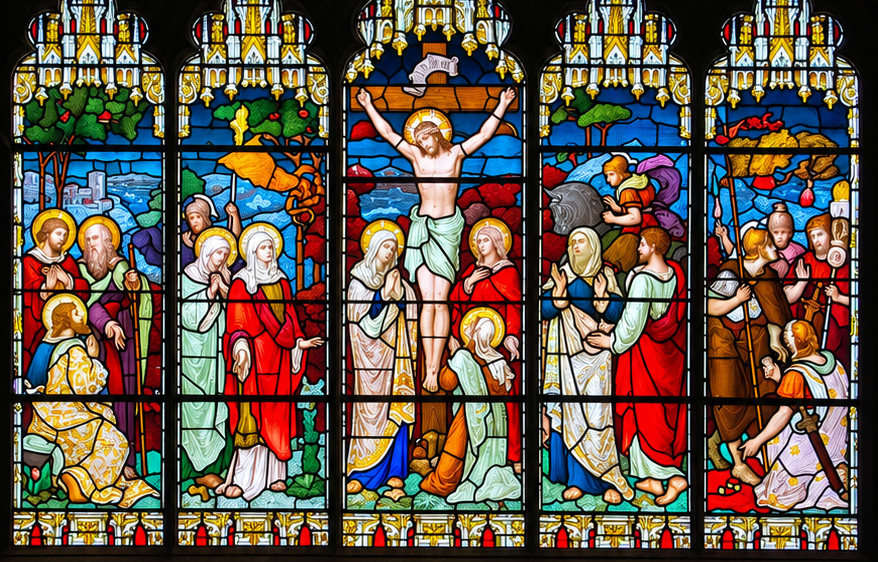
Pictured: Stained glass in St Michan’s, Halston Street
 Donate
 Volunteer
 Mass Times